
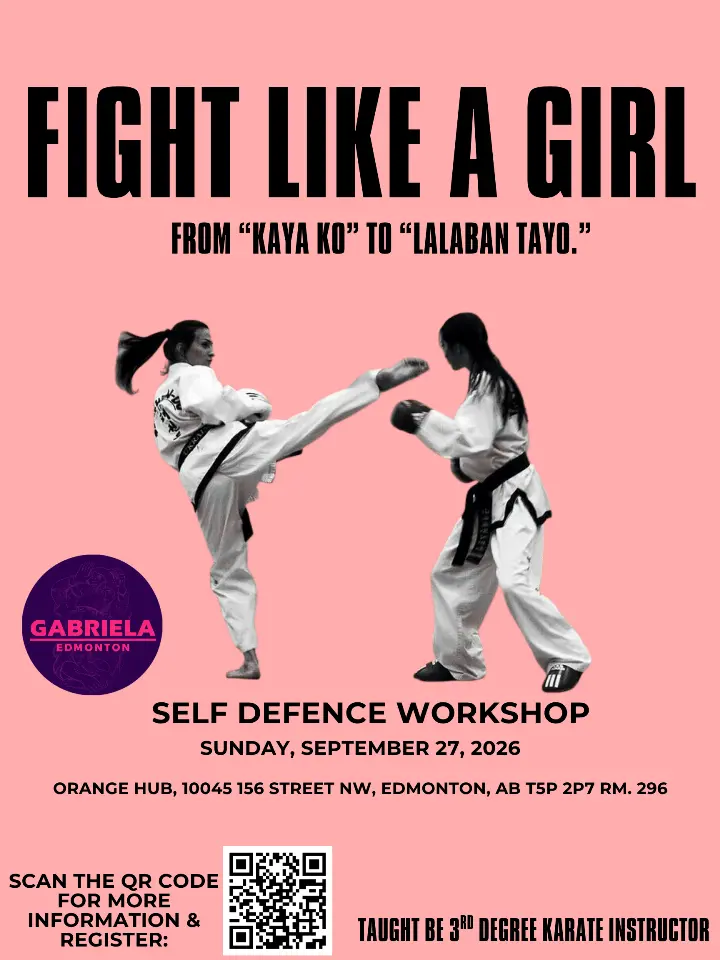
Fight Like a Girl
Details
Northern Alberta
The Idea
Fight Like a Girl is a community led-women's safety initiative that will provide two free trauma-informed self-defence and collective defence workshops for approximately 40-50 women in Edmonton, followed by a community education discussion.
The project grew out of TINDIG! Women Resisting Violence and Exploitation, a 3-day workshop that explored how women experience violence, exploitation, coercive control and social pressures to remain resilient even in unsafe situations.
Fight Like a Girl takes a different approach to traditional self-defence. Women will still learn practical skills such as using their voice, establishing boundaries, situational awareness, escaping physical grabs, and reaching safety. However, the project recognizes that violence cannot be prevented simply by teaching individual women to fight back.
Participants will also learn how to recognize warning signs of abuse and coercive control, respond appropriately when another woman discloses evidence, avoid victim-blaming, identify community resources, and understand barriers that may make leaving an unsafe situation difficult.
The project will place particular emphasis on supporting at-risk and vulnerable women, including low-income women, newcomer and immigrant women, migrants, women with precarious status, mothers, caregivers, and women experiencing social isolation. These women may face additional barriers related to finances, transportation, childcare responsibilities, language, housing insecurity, or limited access to trusted support networks.
The final component introduces collective defence, which are practical ways women and communities can support one another. This includes creating a network of women who can assist with accompaniment, safety-planning, resource sharing, childcare, transportation, and connection to appropriate services. We understand that leaving a dangerous situation may require a community of empathetic and trauma-informed women who can stand beside survivors as they rebuild safety, stability, and confidence.
Each participant will receive a Collective Defence Toolkit containing practical safety information and local resources. The toolkit will include information relevant to newcomer, immigrant, refugee, migrant and women with precarious status, as well as women experiencing financial hardship or other barriers to accessing support.
Who Will Benefit?
The project will primarily benefit women in Edmonton and surrounding Northern Alberta communities, with a particular focus on women who may face increased risk of violence, exploitation, social isolation, or barriers accessing support.
This includes low-income women, immigrant women and newcomer women, racialized women, migrant women, women with precarious status, mothers, caregivers, students, young adult women, and women experiencing financial hardship.
Fight Like a Girl originally grew from conversations within the Filipino community through the TINDIG! Workshops. Participants discussed how women are frequently expected to be strong, resilient, patient, and self-sacrificing even when facing difficult or unsafe circumstances. Those conversations highlighted a broader need for programming that does not simply tell women to become stronger, but helps build supportive networks around them.
The project recognizes that safety is often influenced by factors beyond physical self-defence. Women facing poverty, housing insecurity, language barriers, caregiving responsibilities, immigration-related challenges, or limited social support may have fewer options when responding to unsafe situations. Fight Like a Girl will address these barriers by providing free workshops, childcare support, transportation assistance, resource information, and opportunities to build supportive community networks.
The project will welcome women from different backgrounds while creating opportunities to discuss how factors such as income, immigration status, family responsibilities, isolation, housing, and access to resources can affect women's safety and choices.
Approximately 20-25 women will participate in each of the two workshops, allowing the physical self-defence component to remain practical and interactive while reaching approximately 40-50 women overall. No previous self-defence experience will be required, and participants will never be expected to disclose experiences of violence.
Children and families may also benefit indirectly when women have stronger support networks and greater knowledge about recongizing violence, navigating resources, and accessing support services.