
BeeCube Re-imagined
Lacombe Composite High School Ecovision
Details
Northern Alberta
The Idea
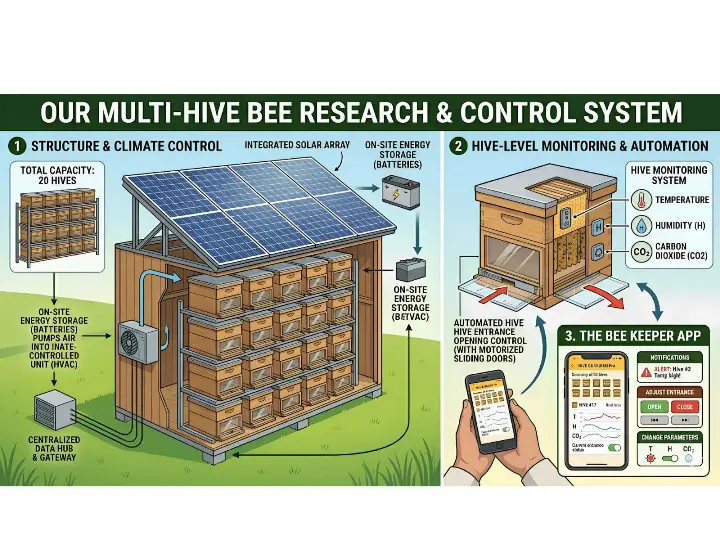
The BeeCube is a student-designed, solar-powered, climate-controlled beehive created to boost honey bee survival, health, and productivity in Alberta’s harsh climate. Developed after students experienced severe winter colony losses firsthand, this project uses affordable technology to help beekeepers detect and resolve hive issues early.
How It Works
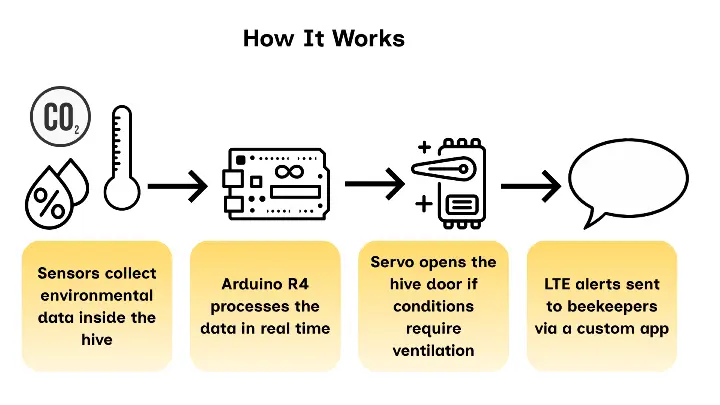
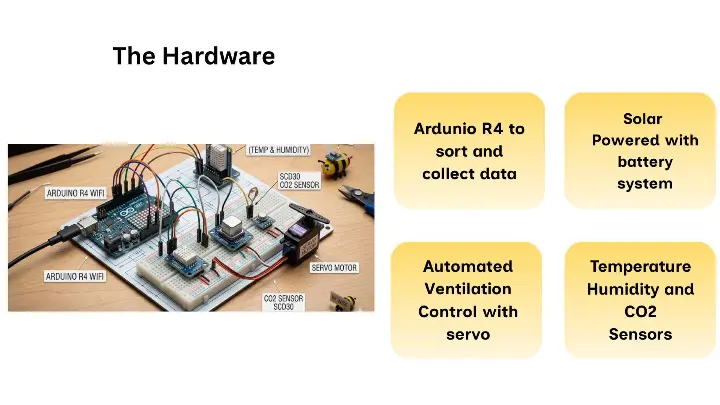
- Real-Time Monitoring: Internal sensors track temperature, relative humidity, and $\text{CO}_2$ levels.
- Smart Alerts: A microcontroller collects and wirelessly transmits data, alerting beekeepers to dangerous shifts without requiring them to disturb the colony by opening the hive.
- Off-Grid Climate Control: Solar energy powers the sensors, wireless communications, and active ventilation to stabilize internal conditions during extreme summer heat and winter cold.
Student-Led Innovation & Impact
Students will apply robotics, electronics, programming, and environmental science to build and test the prototype. Over the season, students will compare BeeCube colonies against traditional hives, tracking winter survival rates, temperature stability, honey production, energy use, and overall health.
By combining renewable energy, automation, and practical design, the BeeCube aims to provide a low-cost, scalable tool that strengthens local food security, supports climate adaptation, and protects vital agricultural pollinators.
Who Will Benefit?
The BeeCube project creates a multi-layered impact across the agricultural and educational sectors through an affordable, technology-driven approach to pollinator health:
- Honey Bees & Pollinators: By actively monitoring temperature, humidity, and CO2, the BeeCube creates a stable internal microclimate. This directly reduces colony stress, improves winter survival rates, and builds stronger, more resilient pollinator populations.
- Beekeepers & Agricultural Producers: Remote, real-time monitoring and automated alerts allow producers to intervene before colony loss occurs—minimizing the need for disruptive manual inspections. Solar-powered operation makes it ideal for remote yards, ultimately reducing stock replacement costs and ensuring stable honey yields and pollination services.
- Students & Educators: Serving as an applied STEM platform, the project gives students hands-on experience in robotics, electronics, programming, renewable energy, and environmental science. Students learn to analyze real agricultural data, troubleshoot hardware, and solve real-world sustainability challenges.
- Researchers & Community: Long-term environmental data collection offers key insights into hive microclimates for agricultural research. By sharing this low-cost, open-adaptability design, the initiative strengthens local food security, supports climate adaptation, and provides scalable technology for the broader agricultural community.