
AI Education for Seniors: Speak to AI, Control a Virtual World + Put Your Memory to Work
Details
Northern Alberta
The Idea
AI for Seniors is a community project built on a simple idea: older adults should not be left out of Canada’s AI future. Canada is investing in AI literacy, but learning about AI should not mean sitting through another lecture about ChatGPT. Seniors should be able to experience it for themselves.
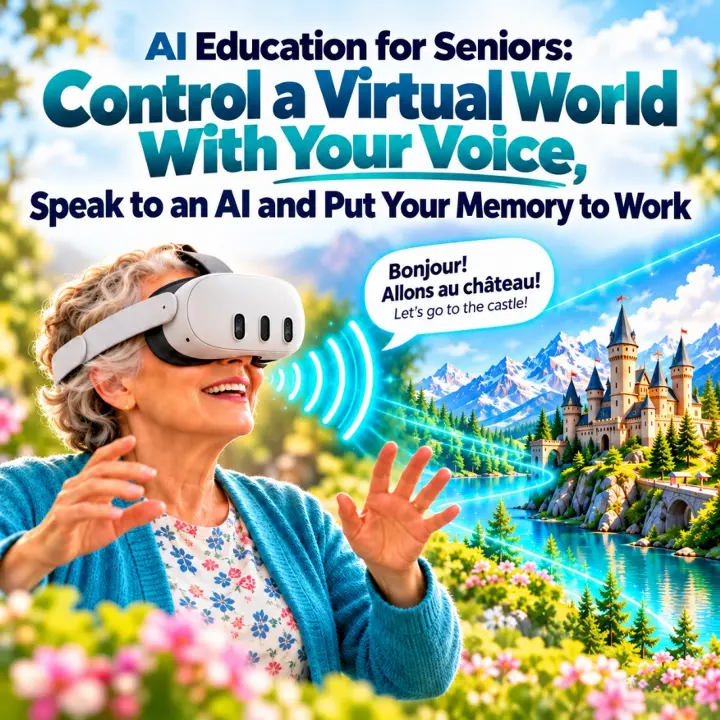
We already have the technology. Our Immersive Mind & Memory Program (IMMP) is a seated, guided VR experience built for cognitive engagement. It is research-informed by work on new learning, active recall and immersive technology with older adults, including research led by Dr. Denise Park at the University of Texas at Dallas, work at Cornell, and related VR and cognition research at the University of Alberta.
Inside the virtual world, participants speak to an AI and use their own voice to control what happens. Here is the twist: they speak French, but they do not need to know French beforehand. French is used as a stimulus for new learning and cognition — something unfamiliar to learn, remember and retrieve — not as the end goal of the program.
Participants do much more than speak. They read, write, listen, speak and draw. They also complete everyday activities such as brushing their teeth, feeding a dog, making toast and playing a virtual piano. This is NOT a passive watching “trip to Paris” video inside a headset scenario. Participants must interact, remember and respond. If they do not speak, the experience does not move forward.
The program uses active recall: participants are asked to remember what they learned instead of simply seeing the same information again. They can return to the same environment over several weeks and build on what they remember.
The project is designed to remove barriers. Participants remain seated, and we bring the headset, team and activities directly to local senior centres, churches and community groups. They do not need to travel, buy technology or search for a specialized program.
The technology already exists. Field Law’s support would help us take it off the shelf and put it directly into the hands of older adults in their own communities.
On top of IMMP, we run hands-on AI literacy sessions. Participants experience AI CLONING by creating, with consent, their own face or voice clone, helping them understand how to spot fake content. They also explore tools such as Google Flow and Veo and create videos and music using their own voice, words and ideas
Who Will Benefit?
Who will it benefit?
- Canada’s AI-literacy goal
Why: The Government of Canada has launched a national AI literacy initiative to help Canadians understand and use AI responsibly.
How: We bring that goal to older adults through hands-on AI, safety education and community delivery. - Older adults in Edmonton and Northern Alberta
Why: Age, cost or lack of access should not exclude anyone from AI or VR.
How: We bring a seated, guided experience to senior centres, churches and community groups. No headset, travel, French or AI experience is required. - Older adults who want to keep learning and mentally engaged
Why: IMMP is built around new learning, memory and active recall.
How: Participants read, write, listen, speak, draw and complete tasks over several weeks, then return to see what they remember. - Older adults who are unsure about AI
Why: AI is becoming part of everyday life.
How: Participants experience conversational AI, AI video, AI CLONING, voice tools and AI music while learning about privacy, fake content and scams. - Senior centres, churches and community organizations
Why: Many cannot afford multiple headsets, specialized staff or new technology programs.
How: One headset can support 6–8 people taking turns as a group. We bring the equipment and team, keeping cost and workload low. - Host organizations and university research
Why: Centres need to see whether participants are engaging, learning and remembering over time. Related VR, cognition and MCI (mild cognitive impairment) research is already happening at the University of Alberta.
How: We provide engagement and progress reports showing participation, recall and learning across weeks. Centres can track progress and, with consent, share it with families. The same information can support future independent evaluation, including potential research with older adults with MCI. - Families and the wider community
Why: AI-safety knowledge can spread beyond each participant.
How: Participants can share what they learn about cloning, scams and fake content with family and friends.
We expect to reach 150–200 older adults across 10–12 community organizations. To the best of our current research, this is a first-in-Alberta model in this format, combining new learning, active recall, conversational AI in French and voice-controlled VR.